
BONHAM, Texas - Complaints from neighbors prompted Bonham police to remove 209 cats and three dogs from a home apparently overrun by the animals. The SPCA helped take custody of the animals Friday.
Officials found 40 cats in one bedroom.
Bonham Police Chief Mike Bankston said the situation apparently got well out of hand for the couple living in the house.
Owner David Wheeler told WFAA television that they started with just 13 cats, but the animals quickly bred. Wheeler said it's expensive to spay and neuter so many cats, plus feed them.
Information from Steve Stoler of WFAA-TV: http://www.wfaa.com/
Monday, February 4, 2008
Police Remove 209 Cats and 3 Dogs from Home
Saturday, January 26, 2008
Pair accused of stealing, eating dog pet
Wed Jan 23, 8:30 PM ET
HONOLULU - Two former golf club employees have been charged with theft and cruelty to animals in the death of a pet dog the owners say was cooked and eaten.
An Oahu grand jury indicted Saturnino Palting, 58, and Nelson Domingo, 43, both of Kalihi, after the Moanalua Golf Club fired them as maintenance workers.
They are charged with stealing a dog owned by Frank Manuma and his wife, Debbie Weil-Manuma. The 8-month-old German shepherd-Labrador mix named Caddy had been tied up near a maintenance shed on Dec. 16 while Frank Manuma played a round of golf.
Manuma said police told him the two men butchered and ate his pet.
The charges are both felonies punishable by up to five years in prison and a $10,000 fine.
"We're delighted that it's moving forward," Manuma said when told of the grand jury indictments.
He said the club had given him permission to bring the dog to the club.
Witnesses told golf club officials they saw the workers load the dog into a car and drive away at the end of their shift on Dec. 16. Both were fired after the incident.
Manuma said he and his wife considered the dog like a child they never had. When the arrest was first reported, they received expressions of sympathy and offers of new dogs from as far away as Colorado.
He said they now have a 3-month old mixed German shepherd-Golden retriever named Caddy 2.
Friday, January 25, 2008
Dog Hospitalised for Being Over the Limit

VIENNA (AFP) - A dog was admitted to a veterinary clinic in Austria at the weekend, barely able to stand on his own four paws and reeking "like a beer hall," a newspaper reported on Monday.
Dingo, a three-year-old labrador weighing 40 kilogrammes (88 pounds), was a pitiful sight when his owner, a hunter, brought him in to the surgery in the Salzkammergut region, the Oberoesterreichische Nachrichten quoted vet Karl Hofbauer as saying.
"The dog had dreadful wind and diarrhea, and was vomiting a lot," Hofbauer said.
"When I got him up on the table, it smelt like a distillery."
Tests indicated that the dog had a blood alcohol content of 1.6 milligrams per 100 millilitres.
But that was not the result of Dingo having one drink too many, the owner insisted.
The hungry pooch had stolen and secretly devoured half a kilogramme of fresh yeast dough from the kitchen. Alcohol had formed inside his stomach as a result of the fermentation process, leaving poor old Dingo stone drunk.
"Nasty-minded people said that we hunters are often drunk. With me, it's my dog," joked the owner.
Dog Tossed from MO Overpass.
Fri Jan 18, 9:38 PM ET
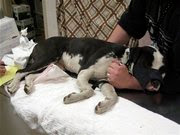
ST. LOUIS - A pit bull terrier that suffered two broken legs and nerve damage when it was thrown 30 feet from an overpass has been euthanized, the Humane Society of Missouri said Friday.
Humane Society veterinarians made the decision Thursday night after consultation and examination, veterinarian Melinda Fleming said.
"This dog was in severe, nearly uncontrollable pain and it was questionable whether he would be able to walk again," she said. "That someone would allow a pet to be abused in this way is unthinkable and heartbreaking."
The organization got a call Wednesday evening from a witness who saw the pit bull terrier and a large golden retriever or Akita mix falling from the overpass in north St. Louis. Authorities believe the dogs were thrown.
The other dog ran away but may have been seriously injured, the Humane Society said. A team from the Humane Society along with city Animal Control and police are looking for the missing dog. So far, they have no confirmed sightings.
The Humane Society has offered $2,500 for information leading to an arrest and conviction. Witnesses were urged to call the Humane Society or police with information.
ST. LOUIS - A pit bull terrier that suffered two broken legs and nerve damage when it was thrown 30 feet from an overpass has been euthanized, the Humane Society of Missouri said Friday.
Humane Society veterinarians made the decision Thursday night after consultation and examination, veterinarian Melinda Fleming said.
"This dog was in severe, nearly uncontrollable pain and it was questionable whether he would be able to walk again," she said. "That someone would allow a pet to be abused in this way is unthinkable and heartbreaking."
The organization got a call Wednesday evening from a witness who saw the pit bull terrier and a large golden retriever or Akita mix falling from the overpass in north St. Louis. Authorities believe the dogs were thrown.
The other dog ran away but may have been seriously injured, the Humane Society said. A team from the Humane Society along with city Animal Control and police are looking for the missing dog. So far, they have no confirmed sightings.
The Humane Society has offered $2,500 for information leading to an arrest and conviction. Witnesses were urged to call the Humane Society or police with information.
Thursday, December 27, 2007
Puppy Mill Prison
The pups in pet store displays are adorable—wriggling balls of energy just waiting to jump into customers' arms. Store owners count on love at first sight because it prompts people to shell out hundreds of dollars to take cute puppies home. It should be a happy ending: The dog gets a home and the store turns a profit. But there is an unseen, darker side to the story. As long as pet shops churn out puppies, unwanted dogs in animal shelters will be killed. And most pups sold in stores come from hellholes called puppy mills, where mother dogs and "studs" spend lonely lives in miserable cages, producing litter after litter, like so many widgets off an assembly line. For months a PETA investigator worked at Nielsen Farms—a puppy mill in Kansas. His job was to feed, water and clean up after hundreds of dogs condemned to small wire enclosures. The animals had no comforts—no bedding on the hard wire, little to no protection from the searing hot summers or the frigid winters and no regular veterinary care, even when they were ill. Crusted, oozing eyes, raging ear infections, mange that turned their skin into a mass of red scabs, abscessed feet from the unforgiving wire floors—all were ignored or inadequately treated. An Australian cattle dog with a palm-sized sore on her back was never seen by a veterinarian and the wound did not heal properly. Some dogs, caught in the wire of their cages, injured their feet and hobbled painfully around, trying to balance. Our investigator also discovered that the collar on a Labrador retriever had not been adjusted as the dog grew and had become embedded in his flesh. Even though the gangrenous skin fell away as the collar was removed, it was treated with nothing but a worm-repellant spray. Timid dogs were terrorized by their more aggressive cage-mates, who often prevented them from eating and drinking. Conditions were also unsafe. Several Labrador pups escaped from their poorly built kennel, and one was killed by other dogs in an adjoining run, yet the fence was never fixed. Perhaps most heartbreaking of all were the old mother dogs who had gone mad from confinement and loneliness. Our investigator watched these poor dogs circle frantically in their small cages and pace ceaselessly back and forth, back and forth, oblivious to anything but the pattern of their strange behavior—their only way of coping with their despair. The tragic conditions at Nielsen Farms are typical of the hundreds of puppy mills that litter the Midwestern states. Laws offer little protection and are poorly enforced by U.S. Department of Agriculture employees, whose visits are infrequent and usually announced ahead of time. Our investigator witnessed one USDA inspection. The inspector glanced at the cages but did not examine the dogs. Later, the inspector asked for an employee's home phone number, then called and asked her for a date. Just weeks after PETA's investigation of Nielsen Farm revealed tiny, filth-encrusted cages and sick dogs with raging ear infections, disfiguring mange and open, untreated wounds, the Kansas puppy mill closed its doors—one dilapidated breeding farm fewer to supply the pet store puppy trade. The U.S. Department of Agriculture has also charged the farm's owners with violations of the federal Animal Welfare Act. Puppy mills such as Nielsen will continue to operate and profit as long as people buy puppies from pet stores. The public has the power to end the suffering of dogs in puppy-mill prison. You can help reach consumers and make a huge difference for dogs who, like your own companions, deserve decent homes.
Dog Fighting
A dogfight is a cruel activity in which two dogs are forced to fight for the sake of human entertainment and profit. The dogs, usually pit bulls, Rottweilers, or Dobermans, are raised under horrific conditions and abusively trained to be aggressive. Humane officers and other law enforcement agents routinely break up illegal dogfighting rings and confiscate dogfighting paraphernalia, including treadmills used to build the dog's endurance and drugs used to numb pain from injuries or to "jazz up" the dogs. They often find mesh bags, which are used to suspend kittens, rabbits, puppies, and other small prey above the dogs to encourage a "fighting spirit." Sadly, they often find many dead and dying dogs, too. Dogs who do survive often sustain serious injuries, such as broken bones and crushed cartilage. Many suffer and die from blood loss, shock, dehydration, exhaustion, or infection hours or days after a fight. Dogfighting is illegal in all 50 states and the District of Columbia. It is a felony offense in all but two states—Idaho and Wyoming—where it is a misdemeanor. Because dogfighting is a felony in most states, dogfighting rings are difficult to infiltrate and are run by extremely dangerous people. If you think dogfighting is taking place in your area, please contact your local humane society or police department to investigate. You can also help spread the word about dogfighting by writing a letter to the editor of your local paper. For tips on writing effective letters, see "The PETA Guide to Letter-Writing." You may also want to contact neighborhood watch groups in your area to encourage them to keep an eye out for possible dogfighting rings.
Subscribe to:
Posts (Atom)


